



In My Own Words
How I Have Come
to Respect Tassels
How I Have Come
to Respect Tassels
BY BARBARA BACIGALUPI
Yes,
TRULYHUMANmedallions
are Tassels
TRULYHUMANmedallions
are Tassels
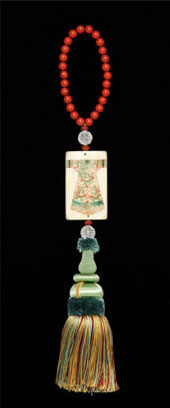
Since their creation over ten years ago, many people refer to TRULYHUMANmedallions as tassels. And for most
people it's a good assumption that this is what they are. TRULYHUMANmedallions can, in fact, be placed just
about anywhere a tassel is typically used whether on armoire keys, drawer pulls or as drapery tie-
backs. But for a long time, I would try to explain why they weren't. I always associated the value of
TRULYHUMANmedallions with the central medallion that was so full of symbolism. For my opinion of tassels in
general, was that they were more of a distracting nuisance. And until I created TRULYHUMANmedallions I had never
personally invested in one.
Rather, my Mom was responsible for the tassels in my home. She always adorned her furniture with tassels, for to her it was just the way that a refined home was accessorized. They truly were a source of delight for her and she often extended the joy she experienced when shopping on Union Square in San Francisco by treating herself to a tassel. But I kept thinking whenever I passed one in my own home "How on earth could these balls of dust catching fluff add anything of worth to my life?" Still, I didn't go so far as to remove them, knowing that each was such a special gift from her.
Years later when I acquired the carved medallions and gemstones that would become the core of TRULYHUMANmedallions, I unexpectedly found myself confronted with the same issue that my Mom sought to address by tasseling my house. I had a loop to make them easy to hang on doors knobs, and a medallion representing a symbol that held great meaning for others. Then, there were connecting gemstones, most importantly rock quartz crystal which to me represented all the clarity and insight we humans seek as we go through life.
Still the design wasn't complete. It needed to be "finished," but I really didn't know how until I started to envision the tassels scattered around my home merging with the design of TRULYHUMANmedallions. It seemed to work all too well. Now the balance and proportion of the overall TRULYHUMANmedallion was good. And as much as I don't like to admit it, the tassels felt good to the touch, in contrast to the hard surfaces of the stones. I was soon to find that I wasn't alone in this reaction. In fact I can't help smiling whenever I recall our first few national showings and how often I enjoyed watching visitors linger inside the exhibit to spend a few minutes petting and stroking the tassels.
So now I really must publically give due credit to tassels, and admit that my TRULYHUMANmedallions are tassels just as much as they are symbolic medallions, having now spent time to better understand how tassels came into being and how history has proven their essential purpose.
Many, many years ago, in fact centuries ago, we humans were faced with a dilemma. When many fibers were lined up side-by-side to create a cord, how could the fibers be secured at the end, so as not to come undone? Knotting the bundle near the end, but so that the ends of the strands remain loose proved to be a useful solution. Most likely this is how the tassel got its start.
Soon the making of tassels took on a life of it's own. Tassels were crafted for the sole sake of producing freestanding tassels, with a loop for attachment protruding from the ornamental knotted top. Also called tufts, the bundles of fibers came to be made from all sorts of fibers - silk, rayon, hemp, ribbons, paper, leather strips, metallic gold and silver strands and eventually from beads and gemstones. To this day the art of making tassels is the subject of books for crafters and artisans worldwide. This is testament to how we intrinsically value the work of the human hand, knowing that indeed it is what separates us from other creatures and allows us to express the creativity and imagination that is inherent to the human mind. During the days when Cro Magnon humanoids decided to shelter themselves in caves, the art of home decoration was born and has persisted and diversified throughout the history of humankind to include tassels several centuries before the birth of Christ. They were found in the tombs of ancient Egyptian pharaohs, and female Greek deities wore skirts made from one hundred tassels.
So what is it about these fibers bundled into a top knot that makes them so universal in their appeal? Tassels successfully established their prominence in both Western and Eastern traditions. Two independent cultures on different sides of the globe reached the same conclusion on the importance of tassels. The Chinese developed tassels in conjunction with their production of silk fabric. Though very feminine in appearance, tassels were held in most high regard by militaries. They were routinely used to indicate rank through the use of different colors, but in ancient China, the wearing of a tassel was strictly reserved for generals. The Japanese Samurai sword was decorated with one, and the Saihai, or the commanders baton used to signal troops, was a lacquered stick with long tassel attached to one end. The Fez, or red felt hat, worn by Middle Eastern armies was topped with a black tassel. The indoor official presentation of the US flag is embellished with three sides of gold fringe and a gold cord with tassels at each end.
That the tassel's history was inextricably interwoven with that of the wealthy and noble class is undeniable. They reached a new pinnacle of importance due to the high regard for tassels shared by both Louis XVI and XV. In the 16 century, Frenchmen formed a guild around the making of passementerie, that is tassels and accompanying ornaments like fringe, gimps, pompons and all forms of decorative trim. So honored was this art form that seven years apprenticeship was required to become a master. After the French Revolution, interest in tassels diminished for awhile, only to rise again as new merchant classes came into being. A new desire to engage in home decoration emerged. By the 1880's gold tassels graced Napoleon's throne, and his bedroom at Fountainbleu featured elaborate red brocades with tassels and tie-backs. In England, tassels reached their height during the Victorian period, during which they just got bigger and so much more elaborate.
Today, unlike so many centuries past, the tassel is within the reach of the vast majority of people and much less a sign of privilege. Still once you become attuned to their presence, the tassel is quite ubiquitous. In home decor, in addition to their presence on keys, they hold back our draperies as tie-backs and serve as chair ties, while some are suspended from chandeliers. They flank both ends of European wall tapestries or Asian brush stroke scrolls. Well-dressed napkins are seen encircled with tassels. Speaking of dressing, the Oxford loafer has always sported them, zippers are often pulled open and closed with one, purses dangle them, graduates routinely switch them from right to left, and burlesque dancers adorn certain parts of their anatomy with them. As in the Victorian times, tassels are now making a prominent statement in fashion forward jewelry designs.
Look for them and you will readily find them. Watch them flow as they move. Touch them and enjoy the texture. For joy of tassels has always been and will continue to be just part of being human.
Rather, my Mom was responsible for the tassels in my home. She always adorned her furniture with tassels, for to her it was just the way that a refined home was accessorized. They truly were a source of delight for her and she often extended the joy she experienced when shopping on Union Square in San Francisco by treating herself to a tassel. But I kept thinking whenever I passed one in my own home "How on earth could these balls of dust catching fluff add anything of worth to my life?" Still, I didn't go so far as to remove them, knowing that each was such a special gift from her.
Years later when I acquired the carved medallions and gemstones that would become the core of TRULYHUMANmedallions, I unexpectedly found myself confronted with the same issue that my Mom sought to address by tasseling my house. I had a loop to make them easy to hang on doors knobs, and a medallion representing a symbol that held great meaning for others. Then, there were connecting gemstones, most importantly rock quartz crystal which to me represented all the clarity and insight we humans seek as we go through life.
Still the design wasn't complete. It needed to be "finished," but I really didn't know how until I started to envision the tassels scattered around my home merging with the design of TRULYHUMANmedallions. It seemed to work all too well. Now the balance and proportion of the overall TRULYHUMANmedallion was good. And as much as I don't like to admit it, the tassels felt good to the touch, in contrast to the hard surfaces of the stones. I was soon to find that I wasn't alone in this reaction. In fact I can't help smiling whenever I recall our first few national showings and how often I enjoyed watching visitors linger inside the exhibit to spend a few minutes petting and stroking the tassels.
So now I really must publically give due credit to tassels, and admit that my TRULYHUMANmedallions are tassels just as much as they are symbolic medallions, having now spent time to better understand how tassels came into being and how history has proven their essential purpose.
Many, many years ago, in fact centuries ago, we humans were faced with a dilemma. When many fibers were lined up side-by-side to create a cord, how could the fibers be secured at the end, so as not to come undone? Knotting the bundle near the end, but so that the ends of the strands remain loose proved to be a useful solution. Most likely this is how the tassel got its start.
Soon the making of tassels took on a life of it's own. Tassels were crafted for the sole sake of producing freestanding tassels, with a loop for attachment protruding from the ornamental knotted top. Also called tufts, the bundles of fibers came to be made from all sorts of fibers - silk, rayon, hemp, ribbons, paper, leather strips, metallic gold and silver strands and eventually from beads and gemstones. To this day the art of making tassels is the subject of books for crafters and artisans worldwide. This is testament to how we intrinsically value the work of the human hand, knowing that indeed it is what separates us from other creatures and allows us to express the creativity and imagination that is inherent to the human mind. During the days when Cro Magnon humanoids decided to shelter themselves in caves, the art of home decoration was born and has persisted and diversified throughout the history of humankind to include tassels several centuries before the birth of Christ. They were found in the tombs of ancient Egyptian pharaohs, and female Greek deities wore skirts made from one hundred tassels.
So what is it about these fibers bundled into a top knot that makes them so universal in their appeal? Tassels successfully established their prominence in both Western and Eastern traditions. Two independent cultures on different sides of the globe reached the same conclusion on the importance of tassels. The Chinese developed tassels in conjunction with their production of silk fabric. Though very feminine in appearance, tassels were held in most high regard by militaries. They were routinely used to indicate rank through the use of different colors, but in ancient China, the wearing of a tassel was strictly reserved for generals. The Japanese Samurai sword was decorated with one, and the Saihai, or the commanders baton used to signal troops, was a lacquered stick with long tassel attached to one end. The Fez, or red felt hat, worn by Middle Eastern armies was topped with a black tassel. The indoor official presentation of the US flag is embellished with three sides of gold fringe and a gold cord with tassels at each end.
That the tassel's history was inextricably interwoven with that of the wealthy and noble class is undeniable. They reached a new pinnacle of importance due to the high regard for tassels shared by both Louis XVI and XV. In the 16 century, Frenchmen formed a guild around the making of passementerie, that is tassels and accompanying ornaments like fringe, gimps, pompons and all forms of decorative trim. So honored was this art form that seven years apprenticeship was required to become a master. After the French Revolution, interest in tassels diminished for awhile, only to rise again as new merchant classes came into being. A new desire to engage in home decoration emerged. By the 1880's gold tassels graced Napoleon's throne, and his bedroom at Fountainbleu featured elaborate red brocades with tassels and tie-backs. In England, tassels reached their height during the Victorian period, during which they just got bigger and so much more elaborate.
Today, unlike so many centuries past, the tassel is within the reach of the vast majority of people and much less a sign of privilege. Still once you become attuned to their presence, the tassel is quite ubiquitous. In home decor, in addition to their presence on keys, they hold back our draperies as tie-backs and serve as chair ties, while some are suspended from chandeliers. They flank both ends of European wall tapestries or Asian brush stroke scrolls. Well-dressed napkins are seen encircled with tassels. Speaking of dressing, the Oxford loafer has always sported them, zippers are often pulled open and closed with one, purses dangle them, graduates routinely switch them from right to left, and burlesque dancers adorn certain parts of their anatomy with them. As in the Victorian times, tassels are now making a prominent statement in fashion forward jewelry designs.
Look for them and you will readily find them. Watch them flow as they move. Touch them and enjoy the texture. For joy of tassels has always been and will continue to be just part of being human.








learning.barbarabacigalupi.com is a part of UMANO, 952 School St, #203 Napa, CA 94559. Copyright © 2020 UMANO Inc All Rights Reserved.